
So you might have finally found the courage to complete the DIY project you have been putting off for months. You know the same project that is supposed to completely upcycle your house? Well, the willpower is there and so are your supplies…but oh.
What is it you said? You don’t have a measuring tape, is it? Ha! That is a good reason to lay off from completing this thing, isn’t it? No. Measuring Tapes didn’t exist before 1829, and people managed to build things, wonders of the world, even, just fine.
So stay put on this article while we teach you how to measure without a measuring tape. By the end of this article, you won’t even be reaching for a measuring tape ever again.
How Does Measuring Without A Tape Help You?
You might think that it is futile to pick up the skill of measuring without a tape, since you won’t ever need it, but it comes in more handy in day-to-day life than you give it credit for.
- To estimate furniture sizes when shopping for it
- Measuring room dimensions when making rough layouts
- Handling quick DIY fixes
- When travelling or working outdoors without tools
- Making last-minute emergency measurements when on the go.
Now, these methods won’t replace professional-grade tools for construction and engineering, but when performed properly, they are quite accurate.
1. Use Your Body as a Measuring Tool
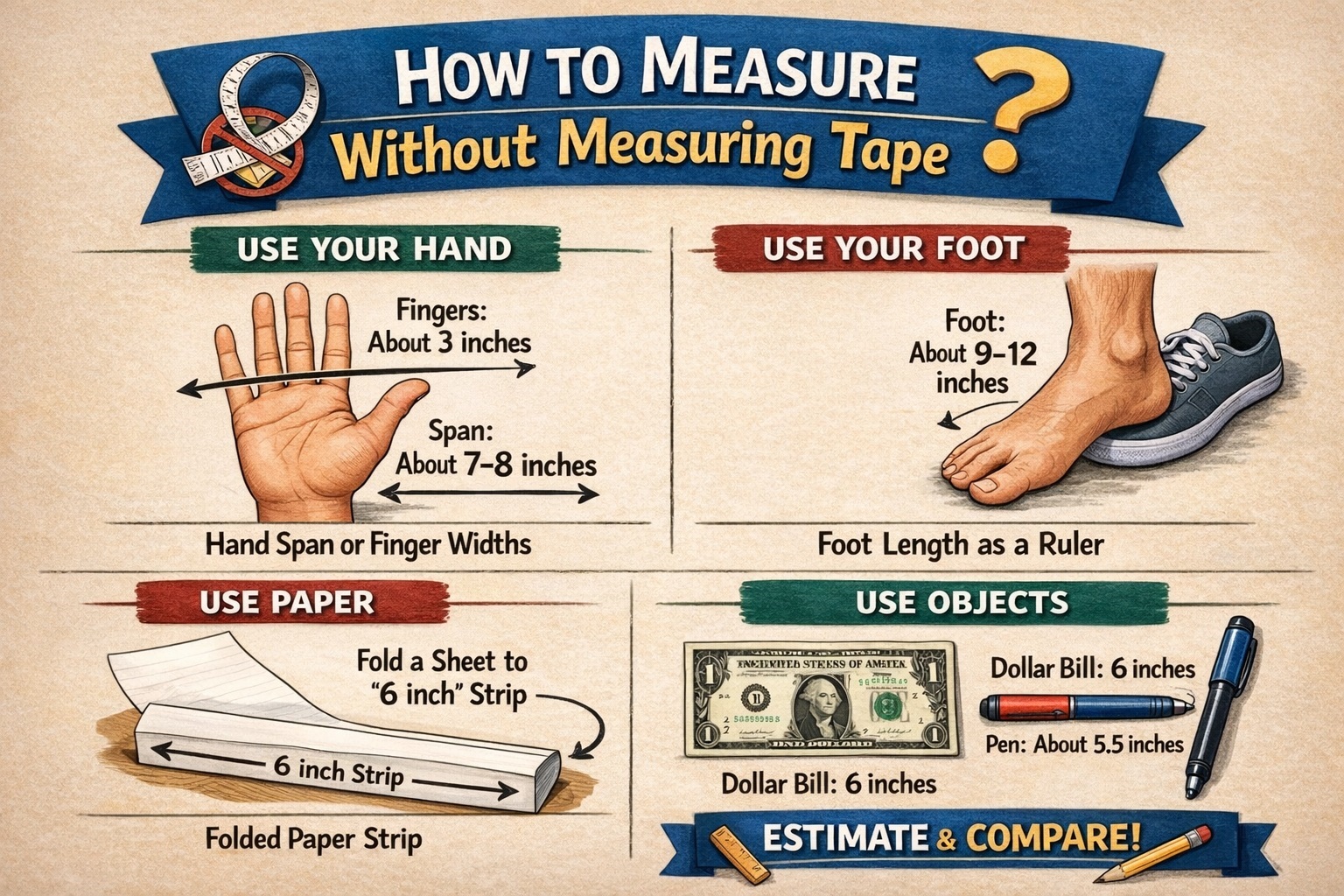
Since the beginning of time, measuring things has been a skill and tool humans have needed. However, the measuring tape was not always with us. In the beginning of time, humans relied on their bodies, mainly arms and feet, for measurement.
Hand Width Method
The typical hand span in adult males, minus the thumbs, is usually between three and four inches. All four fingers together typically measure about three inches long.
These dimensions can be used to estimate the size of small items, such as the distance between two objects.
Arm Span Length Measurement
Arm span length is measured from fingertip to fingertip and is generally equal to overall height. This provides a good estimate when measuring long objects such as furniture, beds ,or even walls.
Measure one arm from the shoulder to the fingertips. Typically normal arm length is thirty to thirty-two inches long.
Arm span (fingertip-to-fingertip length) is generally equal to overall height, so it provides a good estimate for measuring long objects like furniture, beds, and walls.
One arm, from shoulder to fingertips, measures approximately thirty to thirty-two inches long.
Tips to Place Air Conditioning Units in Small Places
2. Measure Using Currency
Currency is a good measuring instrument. Shocking, we know. But currency is more or less the same standard size all over the world and hence makes a reliable tool when measuring.
Here are some common measurements for currencies that are popular:
- A US Dollar Bill is about 6.14 inches long
- The Indian 500 Rupee Note is 5.9 inches
- Most Euro notes are 120-140 mm long.
So if you can lay a bill end to end, you can surface small things, such as the edges of books or furniture.
3. Smartphone As Measurement Tool
A smartphone is also a great everyday common tool to replace a measuring tape, especially in a crucial situation. Firstly, the device in itself is a great tool to measure, but you can also rely on an in-built AR app in the phone itself.
A typical smartphone has a screen size of 5.5 inches to 6.5 inches. But you can always be more precise by finding out your phone’s dimensions.
Now, you can lay down the object one on top of another and then measure using your phone, traveling up and up until your object is completely measured.
Another way is to use an AR app for measuring such as Google Measure (Android) or Apple Measure (iPhone)
AR measurement provides real-world distance measurements using the phone’s camera, sensors, and other sensors, and is significantly more reliable than traditional measurement methods.
How to Fix Common Driveway Problems: Cracks, Stains, and More
4. Common Household Objects
We often don’t consider this when choosing measuring tools, but some common household objects make great impromptu measuring tools because of their standard dimensions.
For example, let us take Paper. A standard A4-size sheet is 11” x 8.3”. Similarly, a US letter-size sheet is 11” x 8.5”, making measurements easier.
Take a paper like this, folding it in half, and you can measure out the width and length of pieces of paper at once as well.
Credit Cards or Debit Cards are also useful for measuring small areas such as wallets, cell phone stands, and shelves. They measure approximately 3.37” x 2.125”.
5. Measure Using String, Rope And Wire
You can accurately measure anything without a tape measure, and the technique described below will help you accomplish that.
1. Take a piece of string and wrap it around whatever area or object you are trying to measure.
2. Mark the string with a finger or with a knot where the two ends of it come together.
3. When done, lay the string down flat on a more accurately measured object (a ruler might work).
This method works great when measuring:
- Round Objects
- Curved Surfaces
- Body Measurements
Top Mistakes to Avoid During Garage Door Installation
6. Wall Markings As Measurement
Use this simple and proven method to measure height accurately!
Directions:
1. Find a straight wall and stand against it
2. With your hand, mark the highest point of your head on the wall
3. Measure the distance between the floor and your mark with:
a) the width of your hands
b) sheets of paper
4. Use two of these methods together for improved accuracy.
Some Common Mistakes To Avoid When Measuring Without Tape
- Do not assume every person will have identical body measurements
- Don’t slouch when measuring height.
- Don’t count steps inconsistently
- Don’t forget that objects overlap when stacking items.
Also, try to stay consistent with measurements and markings when not using a tape measure.
Types of Home Repairs You Should Contact a Professional For
Conclusion
In some ways, not having a measuring tape on you will end up helping you in the long run. By learning a sense of measurement where you rely on everyday random tools, you prepare yourself for events where measurement and spatial sense will help you out a lot more
You will also earn some cool points in every home and crafts project, when you can rely simply on your sense of measurement to do menial measuring work.
