
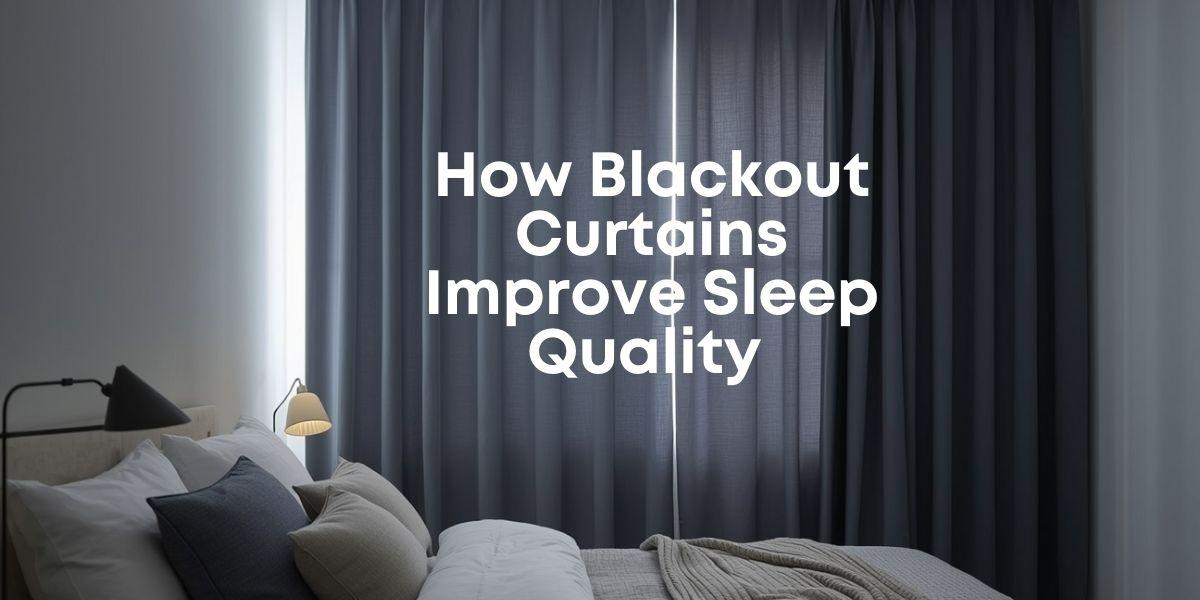
You’ve probably had one of those nights where streetlights bleed through your curtains, or early morning sun wakes you up an hour before your alarm. It’s frustrating, and over time, it genuinely affects how rested you feel. Most people reach for an eye mask or thicker blinds, but blackout curtains solve the problem at the source and do far more than just block light.
This guide covers exactly how blackout curtains work, what they do to your sleep, how to pick the right ones, and what the latest designs actually look like in real homes.
What Blackout Curtains Actually Are? | Key Perspectives
A lot of people confuse blackout curtains with regular thick curtains or “room darkening” curtains. These are not the same thing.
Blackout curtains block between 99% and 100% of incoming light. Manufacturers achieve this through a tightly woven fabric construction, a foam or rubber coating on the back layer, or a triple-weave technology that layers multiple fabric threads to eliminate light penetration completely. Room darkening curtains, by comparison, reduce light by about 85% to 99% but always allow some light through around the edges and through the fabric itself.
True blackout curtains carry a specific lining. The most common linings include white foam coating, black yarn interlining, and silver or cream thermal backing. Each serves a slightly different purpose beyond just blocking light, which we’ll cover shortly.
The Science Behind Light and Sleep
Understanding why light disrupts sleep makes it easier to appreciate what blackout curtains actually do for your body.
Your brain regulates sleep through a hormone called melatonin. Your pineal gland releases melatonin when your environment gets dark, signalling to your body that it’s time to wind down and eventually sleep. When light enters the room, even at low levels, your brain interprets it as a signal to suppress melatonin production and increase alertness.
Research from Harvard Medical School shows that even dim light exposure during sleep, as low as 8 lux, which is roughly the brightness of a nightlight, measurably suppresses melatonin and reduces sleep quality. Blue light wavelengths from streetlights and LED sources cause the most disruption because your photoreceptors are most sensitive to that range.
Blackout curtains eliminate this light input entirely. Your brain stops receiving conflicting signals, melatonin levels stay higher throughout the night, and your body moves through sleep cycles more completely. The result isn’t just falling asleep faster. It means deeper sleep, fewer midnight wake-ups, and waking up at your actual alarm rather than with the sunrise.
Who Benefits Most From Blackout Curtains
Blackout curtains help most people sleep better, but certain groups see dramatic improvements.
Shift Workers and Night Sleepers
Someone sleeping from 8 AM to 4 PM battles full daylight, which the body is hardwired to treat as wake time. Blackout curtains create an artificial nighttime environment that allows proper sleep cycles even in full afternoon sun.
Parents of Young Children
Children’s brains respond to light even more sensitively than adults. A properly darkened room makes nap schedules more consistent and earlier bedtimes significantly easier to establish and maintain.
People with Migraines
Light sensitivity often triggers or worsens migraine episodes. A completely blacked-out room gives immediate relief without relying solely on medication.
Light Sleepers and Insomniacs
Many light sleepers report that eliminating environmental light improved their sleep quality more than any supplement or white noise machine they had tried before.
City Dwellers
Streetlights, car headlights, neon signs, and general urban glow create a baseline brightness that standard curtains never fully block. Blackout curtains eliminate this, giving city residents the same darkness that rural sleepers take for granted.
Practical Benefits Of Blackout Window Curtains
Sleep improvement gets most of the attention, but blackout curtains deliver several other practical advantages that make them worth the investment in almost any room.
Temperature control
Most blackout curtains include a thermal backing that acts as an insulating layer between the window glass and your room. In summer, this reflects heat from sunlight before it enters the space. In winter, it reduces heat loss through the glass. Studies on thermal curtains show they can reduce heating and cooling costs by 15% to 25%, depending on the climate and window size. That saving adds up quickly across a full year.
Noise reduction
The dense, multi-layered fabric absorbs sound waves rather than letting them pass through. Blackout curtains won’t eliminate noise like acoustic panels, but they noticeably dampen street noise, traffic, and neighbourhood sounds. For anyone living near a busy road or in a dense urban area, this makes a real difference to both sleep and daytime focus.
UV Protection
The same lining that blocks visible light also blocks ultraviolet rays. UV exposure fades furniture, flooring, artwork, and fabrics over time. Hanging blackout curtains in a sun-facing room extends the life of everything inside it.
Desired Privacy
Because the fabric blocks light from outside during the day and from inside at night, no one can see into the room, regardless of the time or how bright your interior lighting is.
Types of Blackout Curtains
The market for blackout curtains has expanded considerably. You now have more choices in construction, style, and function than ever before.
| Type | Construction | Best For |
| Foam-backed blackout | Fabric bonded to foam coating | Budget-friendly, good light block |
| Triple weave blackout | Three-layer yarn weave, no coating | Softer drape, breathable, no peeling |
| Thermal blackout | Blackout fabric plus an insulating layer | Energy savings, temperature control |
| Velvet blackout | Dense velvet pile with blackout lining | Luxury look, excellent noise absorption |
| Linen-look blackout | Textured face fabric with blackout back | Natural aesthetic, modern interiors |
| Motorized blackout | Any construction with smart home integration | Convenience, automated light schedules |
Triple weave construction has become the preferred choice among interior designers and sleep specialists because the fabric feels and drapes like a regular curtain, never cracks or peels the way foam-backed versions do after a few years, and blocks light just as effectively. If your budget allows, triple weave is worth the extra cost.
Motorised blackout curtains are growing fast in popularity. Smart home integration through Alexa, Google Home, and Apple HomeKit means you can schedule curtains to close at bedtime and open gradually in the morning to simulate a natural sunrise. This combination of total darkness for deep sleep and a gentle light wake-up is currently considered one of the most effective non-pharmaceutical sleep interventions available.
Blackout Curtain Design Trends in 2025
One reason people used to avoid blackout curtains was that most options looked heavy, dated, or purely functional. That has completely changed.
Linen-Texture Blackout Curtains
Linen-texture blackout curtains sit right at the centre of the natural aesthetics trend. They look like genuine linen from the front while carrying a full blackout lining on the reverse, giving you an organic, relaxed look without sacrificing any light-blocking performance. They blend effortlessly into Scandinavian, coastal, and organic modern interiors.
Earthy Tones Are Taking Over
The cool neutral palette that dominated bedrooms for years is giving way to warmer shades. Terracotta, warm sand, sage green, clay, and dusty mauve are all trending strongly in 2025, bringing depth and warmth to bedroom spaces without making them feel heavy or closed in.
Ceiling-Height Installation
Mounting the rod close to the ceiling and letting panels fall to the floor creates a look that feels expensive and intentional at any price point. It makes rooms feel noticeably taller and eliminates the top-of-window light gap that lower installations always leave behind.
Sheer and Blackout Layering
Pairing sheer curtains with a blackout panel on a double rod gives you complete control over light at any hour. The sheer filters soft natural light during the day. The blackout closes over it at night for total darkness. Two entirely different lighting moods from one window.
Boucle and Textured Fabrics
Boucle fabric, with its looped nubby surface, adds visual warmth and tactile interest that flat fabrics cannot replicate. The blackout lining sits quietly on the reverse while the textured front becomes a genuine design feature, fitting perfectly into the broader trend of layering textures across bedroom soft furnishings.
How To Choose the Right Blackout Curtains
Picking blackout curtains involves more than just choosing a colour. Getting the selection wrong means spending money on curtains that still let light in or look out of place in your room.
Check The Light-Blocking Percentage
Legitimate blackout curtains specify 99% to 100% light blocking. Anything marketed as “room darkening” or “light filtering” does not qualify as a true blackout and will still allow noticeable light penetration.
Look At the Lining
A white foam backing is common and affordable but tends to crack and yellow over time. A black yarn back or silver thermal back lasts longer and performs better. Triple weave construction with no separate lining layer offers the most durable long-term solution.
Consider The Fabric Face
The front of the curtain should match your room’s aesthetic. A functional blackout lining works under any face fabric, so you don’t need to sacrifice style for performance.
Get The Width Right
Blackout curtains need more width than standard curtains to eliminate side-light gaps. Use at least 2 to 2.5 times the window width in total curtain width. Narrow blackout curtains that barely cover the window let light bleed in around both edges and defeat the purpose entirely.
Mount As High & Wide As Possible
Light sneaks in from the top and sides if you mount the rod too close to the frame. Mount the rod within 1 to 2 inches of the ceiling and extend it 6 to 12 inches past the window frame on each side. Pair this with ceiling-to-floor length panels to eliminate every possible light gap.
Installation Tips Specific to Blackout Curtains
- Standard curtain installation advice applies, but blackout curtains need a few extra considerations to actually deliver 100% darkness.
- Mount your rod as close to the ceiling as possible. Even a 3-inch gap at the top creates a visible light strip that grows brighter as the day gets lighter.
- Extend the rod well past the window frame. At least 6 inches on each side keeps the panels well clear of the glass when open and fully covers the frame edges when closed.
- Use enough panels. Blackout curtains that stretch too tightly across a rod pull apart at the centre and create a light gap right where you need darkness most. Two full-width panels with generous gathering always outperform two narrow panels.
- Consider using a curtain with a return, which is a wrap that extends from the end of the rod back to the wall. Returns block side light that sneaks in between the curtain edge and the wall, a detail that makes a genuine difference in complete darkness.
Final Thoughts
Blackout curtains do something surprisingly powerful for something that hangs on a wall. They change your body’s relationship with light, which directly changes how deeply you sleep, how easily you fall asleep, and how genuinely rested you feel when you wake up. The thermal, UV, noise, and privacy benefits on top of that make them one of the highest-return home investments available at any price point.
The designs available today make the decision even easier. You no longer have to choose between a room that looks good and a room that supports great sleep. With the right blackout curtains, you get both.
